
In this section I will cover: Energy conservation, adaptive equipment, getting in and out of a tub or shower, and grab bar placement for a tub or shower.
Energy Conservation and Adaptive Equipment
Plan your bathing time around your own energy levels and your schedule. If bathing wipes you out (and it commonly does) don’t plan to do it in the morning before you need to leave the house. Give yourself plenty of time so you won’t be in a rush to get dressed and on to the next thing. Many people find that they can save energy by putting on a terrycloth robe after bathing instead of drying off with a towel. The robe does the work for you if you are not in a big hurry. A terry cloth turban can do the same job for your hair. You may even want to take a nap in your robe before you bother getting into clothes, and that is just fine. See my page on dressing for suggestions and equipment to make dressing easier.
It is generally a good idea to have a bench or stool to sit on in the shower and this is even more important is one is fighting pain and/or fatigue. Many styles exist and you will want to consider whether you need a back on the stool. Having a back to rest against is very nice if fatigue is a big concern and may also be useful if balance or dizziness are issues. A back does make the stool larger though in many styles the back is optional and can be removed. If space is a big problem but you have a helper in the house ask them to place the stool in the shower behind you after you have stepped in.
Falls and slips in the shower are a real danger so be sure that you have all the items you will need within easy reach. Install non-slip mats or decals on the floor of your tub or shower to decrease the risk of slipping and falling. Once you are situated in the tub/shower, you should not need to get back out with wet feet or reach far outside your base of support. Prior to getting into the tub make sure that everything you need is already in the shower area including towels, wash cloths, sponges, shampoo, conditioner, soap, razors, mirrors, etc.
Grab bars are good for everyone! Young and old, short and tall, seated or standing, everyone benefits from a solid handle to hold onto while stepping or scooting in and out from a tub or shower. See below for advice on grab bar placement and installation.
Many people find it difficult to reach their back or feet and a long handled sponge or brush can make all the difference. Reusable long handled applicators also exist to help with applying lotions and ointments to those hard to reach areas.
Getting in and out of a bathtub
Whether you are taking a bath or a shower, the need to step into the tub can be difficult for many people. A tub transfer bench can be a great solution and there are several designs available. Tub transfer benches typically sit with two legs in the tub and two outside the tub. If you are limited on space, there are benches designed with two legs in the tub and a clamp on the side of the tub rather than having legs on the outside. Most are made of plastic and metal to be light weight and easy to clean. Some are made of teak wood slats which look lovely if you are not deterred by the higher price. Generally, the bench is placed so that the user is facing the water supply and most benches that have a back and armrest can be set up to face either way.
To use a tub transfer bench follow these steps.
1. Back up to the bench until you feel it against the backs of your legs. Use your hands on the bench or on grab bars to help you sit down on the bench in a slow controlled manner. Notice that if you are using a walker, you must let go of the walker before sitting down. See my page on getting up for a review of safe walker use.
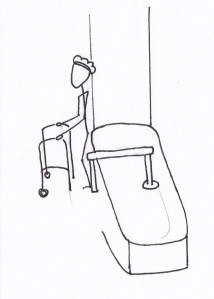
2. Scoot back as far as you can leaving both legs outside the tub.
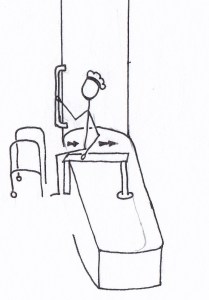
3. Pivot around while you lift your legs into the tub one at a time. If you have trouble pivoting, there are benches designed with a swivel feature that might help. A caregiver can also help with lifting your legs into the tub.
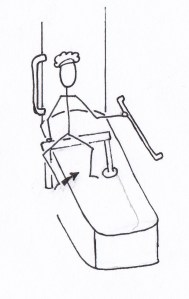
4. Finally scoot over to be sitting fully inside the tub area.
5. When you are finished bathing, reverse the process being sure to first scoot close to the edge of the bench while your legs are still in the tub.
Be sure your feet are dry before you stand up. If reaching your feet is difficult, try sitting on the edge of the bench and shuffling your feet on a dry towel on the floor.
Since the bench extends over the edge of the tub, there is no way to close a sliding door so a shower curtain must be used. If you have sliding doors you may be able to lift the doors off the runners and install a tension rod to use a curtain. The shower curtain should be tucked in around the front and back of the bench during showering to keep water from running outside of the tub. In most plastic tub transfer benches the seat is composed of three sections and I recommend tucking the edge of the shower curtain inbetween two sections to decrease the risk of water escaping onto the bathroom floor. You may want to put down an extra towel or bathmat to soak up any spills.
Depending on the set up and space in your bathroom, a tub transfer bench can take up a lot of space, though it can be stored completely within the tub when not in use. Leaving it set up is convenient if you live alone or are the only one using that bathroom. However, you may find that it is then a tight fit to pass by the tub to access other parts of the bathroom. In placing the bench you will have to consider the position of the water supply, the width of the walkway, and the individual needs of all the users of that bathroom.
Getting in and out of a walk in shower
Depending on your set up you may still have to step over a threshold to access a walk in shower. If you are remodeling, consider options that do not have any threshold. These are typically considered a “roll in” shower and have a soft threshold that will allow a wheelchair or walker to rollover them but still keep water from running out all over the floor.
See below for grab bar placement. You will want to be able to hold onto a grab bar as you step into the shower and continue to hold onto one or more until you are safely sitting on your shower chair.
Do not step out of the shower with wet feet! Have towels within reach so you can dry your feet while still in the shower. You can also shuffle your feet on a dry towel first and have an absorbent non-slip bathmat to step onto.
Grab bar placement
Ideally, your grab bars will be permanently anchored to studs in the wall. If that is not possible, suction grab bars may be used. While their suction is very strong, you are limited by the strength and stability of the wall material. That is, the grab bar may stick to the tiles but will the tiles stick to the wall?!
Grab bars should leave no more than 1.5″ space between the bar and the wall. More than that and a person’s wrist/arm can get trapped!
Grab bars are available from many sources including online stores, home improvement, and hardware stores.
For a tub
Place a vertical grab bar on the wall outside the tub near where you will step in. If you will be using a tub transfer bench and sitting to face the water supply, it may be best to place the grab bar on the far end. See the illustration above. However, if you will be stepping into the tub (not using a transfer bench), placing the outside vertical bar at the water supply end will limit your need to turn around once you are standing in the tub. A second grab bar installed horizontally or diagonally should be placed on the far wall inside the tub area. Typically, horizontal grab bars will be placed 30-36 inches above the floor. If you will be sitting down in the tub for a true bath, place a second horizontal grab bar 8-10″ above the edge of the tub. Vertical grab bars should be at least 18″ long and height will depend on the height and abilities of the persons who will be using it. A longer bar may allow for both standing and seated (possibly from a wheelchair) use.
For a shower
Place a grab bar near the entrance, placing it vertically takes up less space and may make it useful to people of various heights. A second grab bar should be placed within the shower on the far wall, this bar can be placed either horizontally (approx 30-36” above floor) or on a diagonal.
 The Free OT