Getting up on your feet can be difficult for a whole range of reasons and falls frequently happen when a person is trying to get up or sit down. Here are some suggestions to make it easier and safer.
First, and most importantly, prevent the problem!! In other words don’t sit in that low squishy seat with no armrests! I know it is your favorite but if you can’t get out of it, then it’s time to find an alternative! Try to pick a seat that is higher with a firm cushion and preferably with solid armrests.
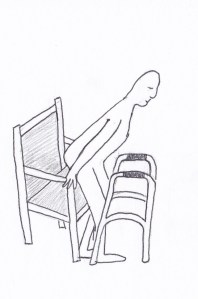
Set yourself up well every time and you will be more successful and safer too. First tuck your feet back under your knees and lean forward. The saying is “nose over toes!”
Place your hands on the armrests of the chair or on the seat itself and push down. Hand placement is the same for sitting down. Let go of your assistive device (walker, cane) and reach back for the surface you are about to sit on. Never pull or push on the handles of a walker. They are not designed to be stable from that angle and will likely tip back towards you.
Do NOT pull on someone’s arm to help them up, it is too easy to accidentally injure a weak shoulder.
Many electric recliner chairs have a lift function that can help a person get up on their feet. These chairs can be beautiful and you can keep it simple or go nuts with features like heating and massage. Just be careful, when using a lift chair, that the seat gets lowered again after you sit down so that you do not slip out onto the floor when you get comfortable. If you have a standard recliner chair and find that the lever is difficult to reach or manipulate this handy lever extender might be useful to you.
Seat assists are a good option that help lift your rear as you push yourself up. They can be used on any standard chairs. Couch canes or bed canes are handles or frames that give you something solid to hold onto and pull or push on while getting up. They usually do not require any changes to the furniture rather they fit under or around the cushions or mattress.
If you simply must keep your low, squishy chairs, you can improve their accessibility by placing a wooden board under the cushion, adding a couch cane and/or adding blocks under the feet to raise them higher. Be sure that any such blocks are firmly anchored to the feet and that the chair cannot be knocked off the blocks.
For the caregiver
To prevent falls when you are assisting, you need to have control over the other person’s center of gravity. Ideally, you will be holding onto a gait belt that is relatively tight over their hips. Sometimes a person’s anatomy or the presence of a wound or fracture will require placement of the gait belt higher but even a gait belt around a person’s chest is better than pulling on their arms. Shoulders are fragile, especially older shoulders and it is very easy to cause a tear or strain by pulling on someone’s arm whether for standing or rolling in bed. If the person has good strength in their arms, encourage them to push down on the arms or seat of their chair while you assist at their hips. If a grab bar is available, they can pull on the bar.
Stand close to the person you are assisting so that you do not need to let go to change positions until they are safely up or sitting down again. Typically, when helping someone to stand up or sit down, you can stand next to them with one hand on the gait belt and the other providing support at the front of the shoulder nearest you. Put both hands on the gait belt if they need extra help. If they are transferring from one seated position to another (for example bed><wheelchair, wheelchair><toilet, etc) then you need to position yourself in front or behind them in between the surfaces that they are transferring between. Avoid leaning and twisting or you may find yourself being the patient!
 The Free OT